
CODE BREAKING
The contradictions in the new Architects Registration Board’s new Code of Conduct (and what it means to potentially ‘break the law’)

I am not sure why it took me so long to resign from ARB (Architects Registration Board) given that the only benefit was being able to call myself an architect, a privilege that costs £205 a year. Perhaps I felt that my professional identity was bound to architecture and so I needed the reassurance of the title (though I suspect that my colleagues at Central Saint Martins, where I spent the last ten years of my professional career, would not have cared in the slightest what I called myself.) When I stepped down as Head of CSM in 2022 to embark on what a friend calls ‘post-ambition’ life, I wrote to ARB to tender my resignation. The response was not exactly friendly. In bold letters, it stated:
“Once you leave the Register, you cannot continue to use the title ‘architect’ in business or practice – to do so would be a criminal offence as set out in the Architects Act 1997.”
It then continued:
“If you incorrectly use the title ‘architect’ after your removal from the Register, you risk breaking the law. We periodically audit resignations from the Register, to reassure ourselves that anyone using the title "architect" is doing so lawfully.”
Given my profile, including at the time 11,000 followers on Twitter (before I left that too), I got paranoid about being checked up on. I therefore now call myself a ‘recovering architect’, a term that raises a wry smile among other architects who are still shackled to the codes and conduct of the profession.
I have always had a problem with the so-called ‘Codes of Conduct’ of ARB and the RIBA. Back in 2007, I wrote in Architecture Depends:
One of the most commonly made mistakes is to confuse professional propriety with an ethical position, as if acting in accordance with the codes of professional conduct will ensure ethical behaviour. It is a confusion encouraged by the ARB, the registration body for architects in the UK. The introduction to their code of conduct states that: “the code should be central to the life of an architect, not only as a source of ethical guidance but also as a commonsense indicator to the principles of good practice.”[i] However, this high-minded intent is simply not delivered in the detail of the code. There are twelve standards listed that must be followed by anyone using the title architect. Just listing keywords from the heading of each standard is enough to show the ethical paucity of the ARB code. Acting with integrity • Adequate professional, financial and technical resources • Truthful and responsible promotion and advertising • Conscientious execution of work • Regard to users • Maintain professional and technical competence • Security of client’s monies • Adequate indemnity cover • Manage own finances prudently • Promote the standards of the code • Organise work responsibly and with regard to clients • Deal with complaints promptly and appropriately. I reckon my hairdresser could meet those standards. In fact, I reckon he exceeds them, having turned down the business of a certain well-known architect who had behaved badly just once too often. The point, as Tom Spector notes, is that these standards are aimed at “clarifying the architect’s responsibilities to the client,” and nothing more.[ii]
The codes make it clear that the work of the architect is primarily framed by the demands of the client. Given that those demands are in turn so often overseen by the market, the claim that the code is a source of ethical guidance is at best disingenuous, at worst a downright dangerous (unless one is deep down the neo-liberal rabbit hole and believes that the markets are in some way mechanisms of high morality).
I therefore looked forward to the new ARB Code of Conduct when it went out for consultation earlier this year, hoping that at least it would acknowledge the ethical emptiness of the earlier version, and also acknowledge climate breakdown and the devastating impacts that had become still more apparent in the intervening years. The proposed new ‘Standard 2’ titled Public Interest, promised much but delivered next to nothing, apart from mealy-mouthed clauses such as “demonstrating respect for life, the law, the environment and the public good.” (Fig. 1)
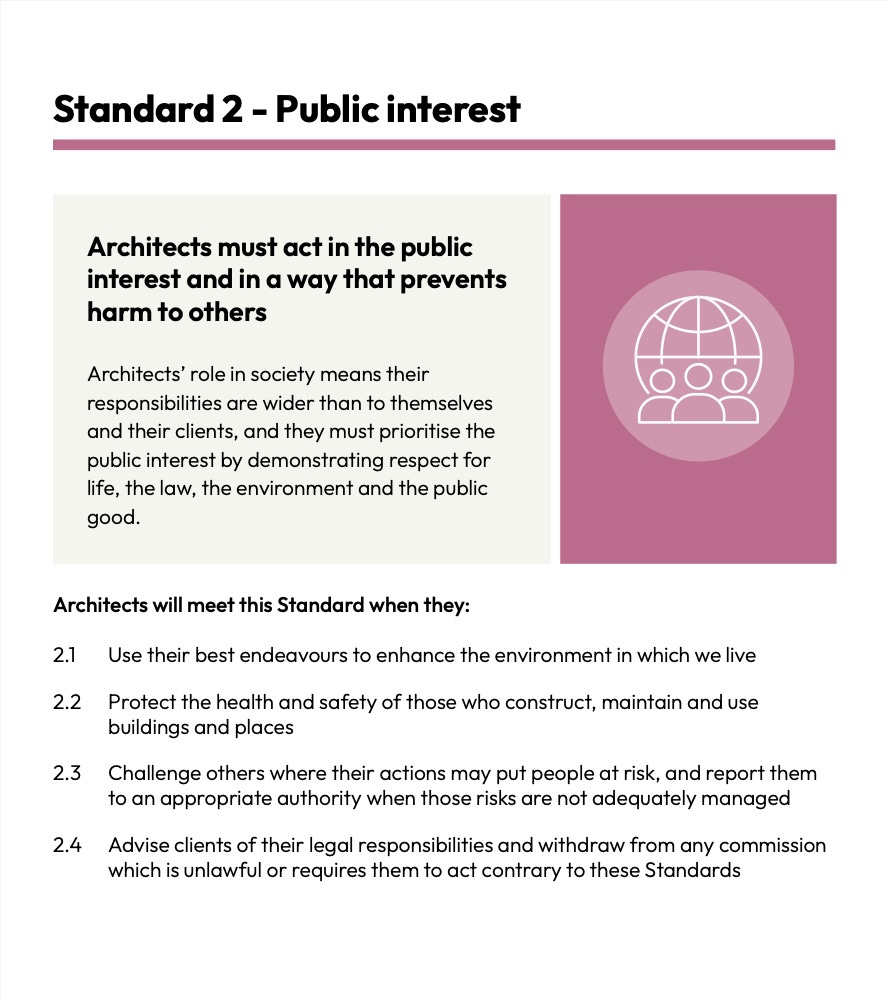
Had a student written that, I would have jumped on them: “Define those terms! What do you mean by ‘the environment’?” However, the final published version of the code retains the vagueness (though the ‘public good’ phrase has been dropped). This casualness is deeply concerning for two reasons: first, the code is the document against which architects can be sanctioned by ARB; and second, ‘the environment’ is so loose a term as to be next to useless in holding architects to account in relation to climate breakdown.
I contributed to the response to the consultation submitted by the Professional Standards group of ACAN (Architects Climate Action Network). We made extensive and, to my mind, completely reasonable suggestions as to how the standard of Public Interest could be improved. We started by noting how weak the code was in comparison to that of other professional bodies, and then argued for a strengthening of the language, for example recommending that the clause:
“Use their best endeavours to enhance the environment in which we live.”
be replaced with:
“Always act in a manner that takes into account the short and long-term impacts of their actions, including on the natural environment and planetary systems.”
Nothing radical, just a more explicit acknowledgement of architecture’s wider responsibilities.
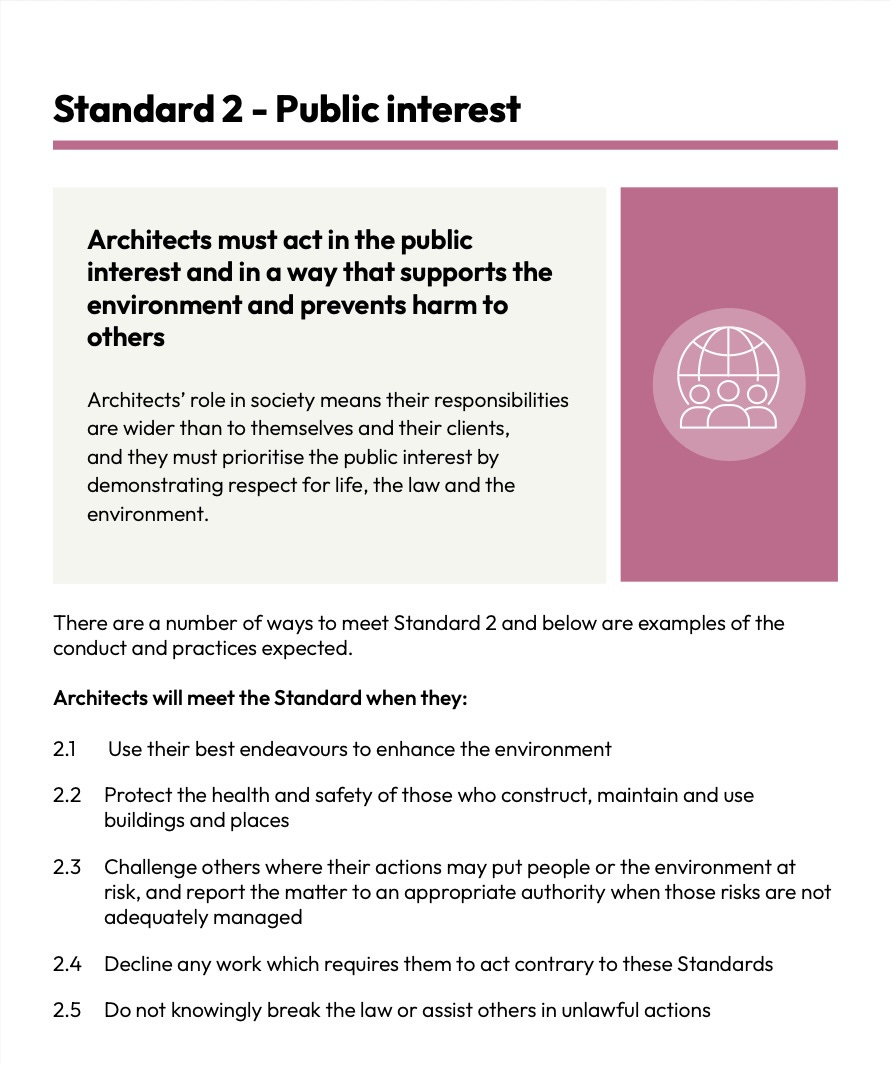
The final published version (Fig. 2) makes a token nod to these concerns by including ‘environment’ in the headline and in clause 2.3. It also, unannounced in the draft, adds an extra clause: “Do not knowingly break the law or assist others in unlawful actions.” And this is precisely where the code becomes fundamentally broken.
.
Readers of this Substack will know that a few weeks ago, four people who were or had been architects, including me, were arrested along with many others under the Terrorism Act of 2002. In the first week of September, the arrestees who are still registered as architects received an email from ARB, noting their arrest. The email stated that ARB would be taking no action ‘for the time being’, but also reminded them of their obligation to inform ARB if convicted. Quite why this email – both consoling and vaguely threatening at the same time – was necessary is not clear. It demanded a response.
Steve Fox’s reply nailed the issue of the broken code:
Thanks for your email.
I'll be pleading not guilty, and maintaining that I'm acting in the public interest and in accordance with my professional obligation to use my best endeavours to oppose genocide and ecocide.
This raises an unfortunate contradiction between clauses 2.1 - 2.4 and clause 2.5, which perhaps should be amended to allow for civil disobedience to challenge unjust laws which violate moral principles or human rights.
Best,
Steve Fox
Nick Newman reinforced this by asking: “Finally, I would also please request information on ARB’s position on what to do if points 2.1 to 2.4 are in contradiction to point 2.5. For example if (architects) believe that continuing their work may make them complicit in genocide or ecocide.” Nick also submitted a Freedom of Information request asking where the final clause of about not breaking the law had come from, given it was not included in the consultation.
ARB’s response noted that it appreciated that “you find yourself in a difficult position.” It is not Steve or Nick who are placed in a “difficult position.” It is ARB. Steve and Nick’s actions are in accordance with the Standard’s headline (“Architects must act in the public interest and in a way that supports the environment and prevents harm to others.”) Their participation in the protest directly challenged the government's inaction regarding the Palestinian genocide, and is therefore consistent with clause 2.3 (“Challenge others where their actions may put people or the environment at risk and report the matter to an appropriate authority when those risks are not adequately managed.”) Conversely, by remaining silent about the genocide, architects might actually fail to meet the requirements of clause 2.3 because they have not challenged others.
Equally, none of us ‘knowingly’ broke the law. An arrest is not the same as a conviction, and we all plan to plead not guilty. If we are convicted, then ARB would have to decide which clause of the Public Interest section of their code takes priority or (better) admit to the internal contradictions and go back to the drawing board. They were given enough advice in the consultation but chose to ignore most of it, as even a cursory comparison between the two versions makes clear. The ARB code, in all its equivocation and deference to client priorities, was already compromised. The arrest of two architects and two recovering architects might just break its back.
Footnotes
[i] Architects Registration Board, "Code of Conduct," (ARB, 2002), 3. My emphasis.
[ii] Tom Spector, "Codes of ethics and coercion," in Architecture and its Ethical Dilemmas, ed. Nicholas Ray (London: Routledge, 2005), p. 102.